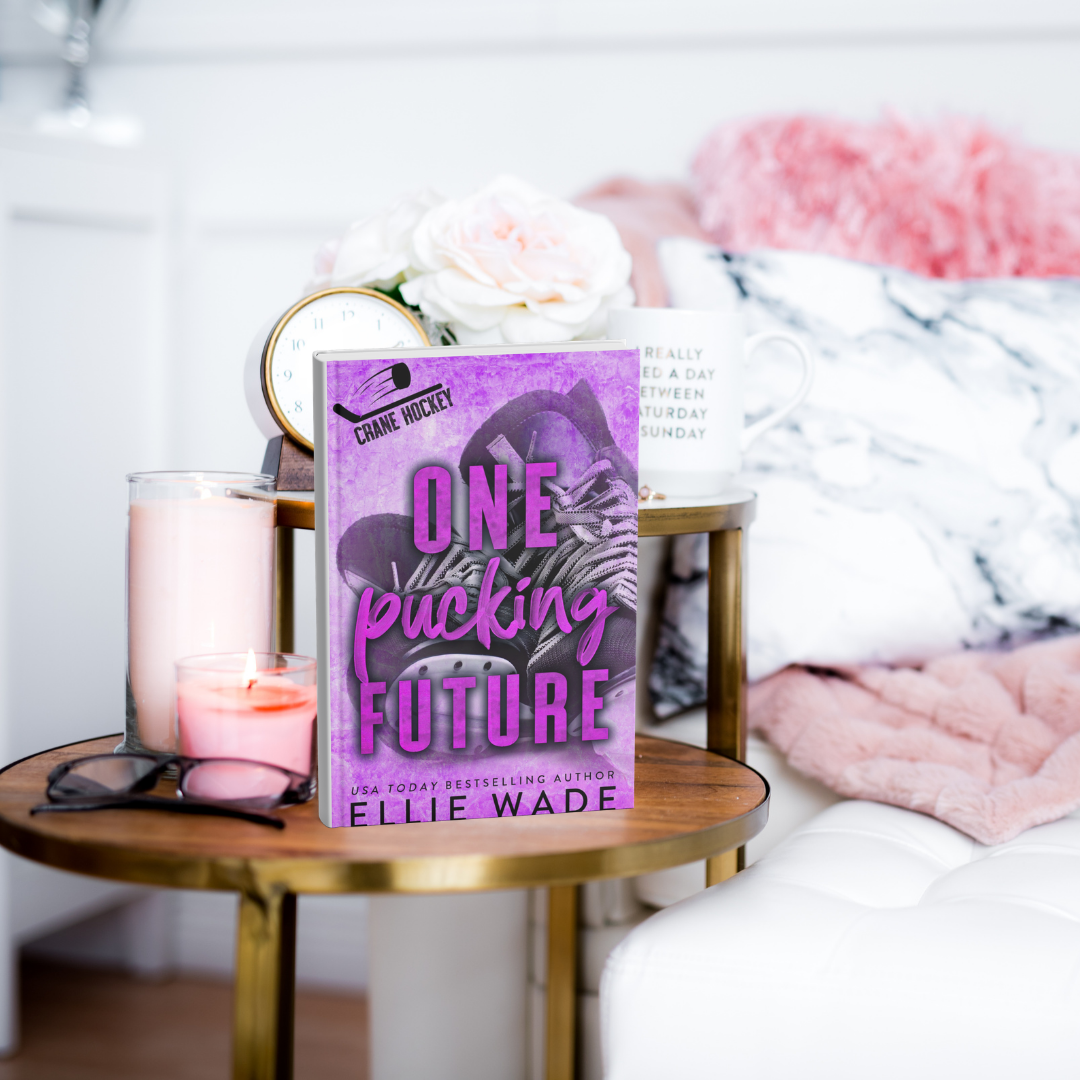

One Pucking Future Paperback
One Pucking Future Paperback
Ellie Wade
Couldn't load pickup availability
- Purchase the Book
- Receive Download Link via Email from Bookfunnel
- Send ebook to Preferred E-Reader/Stream audiobook or listen on BookFunnel app and Enjoy!
- ..............................
From USA Today best-selling author Ellie Wade comes an emotional, enemies-to-lovers, second-chance hockey romance.
Finn Callahan is living the dream as a professional hockey player for the Cranes. With a promising career and a reputation for keeping things light, the last thing he expects is for his past to walk back into his life—especially the one woman he’s never been able to forget… or forgive.
Kelsey Albright is the coach’s daughter, and returning home was never part of the plan. But life has a way of pulling you back to where it all fell apart. The last person she wants to face is Finn—the boy who once meant everything to her… and the one she believed destroyed it all.
Seven years ago, their love ended in betrayal, heartbreak, and silence. Now, forced back into each other’s orbit, the tension between them is undeniable. So is the chemistry.
But the truth about their past threatens to rewrite everything they thought they knew.
As old wounds reopen and buried feelings resurface, Finn and Kelsey must decide if what they had is worth fighting for… or if some love stories are better left in the past.
Because this time, it’s not just about second chances.
It’s about their future.
Preview the Story
Preview the Story
Chapter One
Kelsey
I promised myself I wouldn’t regret this move.
It’s been seven years since I’ve set foot in Michigan. My last childhood home—or the closest thing I had to one. My parents moved here during my freshman year of high school, when my dad accepted the head coaching job for the Cranes. I only lived here for three years before everything fell apart, but when I picture “home,” this place still comes to mind.
I left with every intention of never coming back.
Thankfully, my dad’s schedule made that easy. We never built traditions here. No holiday routines or yearly gatherings that would pull me back out of obligation. When he had a few days off during the season, he and my mom flew to wherever I was instead—usually California. We spent Christmas in hotel suites more often than houses, and it worked for all of us. There were no awkward questions or difficult conversations about why I didn’t visit.
The honest truth is that I don’t want to be here now. In fact, I’d rather be anywhere else.
The second I stepped off the plane in Detroit, my body knew it no longer belonged here. Since then, my shoulders have remained tight, pulled up toward my ears as if I’m bracing for impact. My jaw constantly aches from clenching. Every instinct screams at me to turn around, get back in my car, and drive straight to the airport.
But my mom asked me to come back. And she had her reasons, important ones. My dad offered me a job, so here I am.
I’m the operations manager for the Crane Organization. That’s the title printed on the paperwork sitting in my new office and embossed on the badge clipped to my blazer. It sounded substantial when he said it over the phone a couple of weeks ago. When I looked up the job description online, it listed logistics coordination, travel management, scheduling oversight, compliance monitoring, and game-day operations.
In reality, Penny Dreven and Iris Richards already run all of that with ruthless efficiency. Penny especially could manage a small country if she felt like it—and probably has, judging by the authority she carries and the respect others give her. There’s no gap for me to fill, and no broken system waiting for my organizational skills. I don’t foresee myself swooping in to save the day anytime soon. The place is a well-oiled machine that doesn’t need me.
Granted, I’ve only been here three days, but I’m not feeling optimistic that I’ll find a purpose.
I don’t like that feeling. I never have. I like defined edges, clear expectations, and measurable outcomes.
Right now, “operations” apparently means errand girl, which is a little below my pay grade, but it’s not my place to argue—yet.
I push open the glass door of the arena’s administrative entrance and step out into the crisp morning air, car keys already in my hand. A Stanford business degree with organizational honors and three internship offers from Fortune 500 companies that I turned down to take this job—yet here I am, about to pick up twelve customized lattes for the front office staff meeting.
The irony isn’t lost on me.
Still, I’ll do it without complaint or attitude because despite fleeing this life seven years ago, I am still an Albright. I am my father’s daughter, and I don’t half-ass anything.
Let’s face it, the whispers have already started. I hear them when I walk into a room—conversations that cut off mid-sentence, eyes that follow me down hallways, and questions no one asks directly but that hang in the air like smoke.
I am the coach’s daughter, back after years away. They surely wonder why I left, why I stayed away, and why I’m back. It’s human nature.
No one questions me directly, but I catch enough fragments to know I’m the topic of conversation. I don’t miss the knowing looks exchanged between people who work here.
I’m not giving them ammunition for office gossip. The last thing I’m going to do is act in a way that indicates I think I’m entitled. I have no problem putting in my dues.
If they need Post-it notes ordered, toner cartridges replaced, or twelve very specific coffee drinks delivered at eight thirty sharp, I’ll handle it without complaint.
I start to pull up Google Maps to search for the closest coffee shop, but Iris, on her way into the building, stops me before I can finish typing.
“Oh, no,” she says, shaking her head with a smile. “The team has a place. You’ll want to go to The Grind.”
She says it as if it’s important, implying that deviating from it would be a mistake.
“The Grind,” I repeat, typing it into my phone.
“Say hello to Layla, Bob, or Joyce when you get there—depending on who’s working.” Iris’s tone is light, but the instruction is clear.
Nothing around here is accidental. The Crane Organization is a fine-tuned machine. Everything runs on quiet systems, unspoken hierarchies, and long-standing relationships that predate my arrival by years.
I’m clearly still learning the machinery.
I unlock my car and slide into the driver’s seat, pulling up the directions to The Grind on my phone. It’s only three and a half miles, a mere ten minutes in morning traffic. In California traffic, that would be double.
I can do this. I let out a breath. I’ve handled worse than coffee runs and sideways glances. I’ve avoided the suffocating weight of a past that threatened to destroy me.
While I know I won’t be able to avoid it forever, I’m going to do everything in my power to avoid that past. I put the car in drive and pull out of the parking lot, trying very hard not to think about the last time I was in this town. More importantly, I refuse to give in to the temptation to think about a certain blue-eyed boy. I can overcome almost anything but him.
***
After a short drive, I park along the street outside the coffee shop. My phone buzzes with a notification from my best friend Nina back in California. I step onto the sidewalk and open her latest post—a carousel of beach photos from yesterday. Our whole group is there—towels, surfboards, sunburned noses, and ridiculous smiles.
I’ve only been gone for a few days, but the distance already feels longer.
I close my eyes for a second and try to summon the salty ocean air and crashing waves. Michigan’s early fall is beautiful—warm, golden, almost gentle—but it isn’t my home anymore. I miss my friends. I miss the life I built there and the version of myself that existed far away from this place and everything that nearly broke me.
Eyes down, thumb scrolling through more photos of bikinis and board shorts and sun-kissed shoulders, I head toward the shop entrance when something slams into me.
The impact knocks the air from my lungs. Hot liquid splashes across my torso, soaking through silk. A cardboard drink tray tilts and crashes, cups and lids scattering across the sidewalk in every direction.
I gasp and jump back. “Oh my—”
“Oh my God,” a man says at the same time. His deep voice is close and genuinely panicked. “I am so, so sorry.”
We both drop to our knees, reaching for rolling cups and skidding plastic lids before they end up in the street.
“It’s fine,” I say automatically even though my blouse is completely soaked and my mood has gone from bad to worse.
“It’s not fine,” he says, quickly gathering cups. “I wasn’t watching where I was going.”
“Neither was I.” I exhale, trying to salvage what’s left of my patience. “Occupational hazard of walking and scrolling.”
“Still my fault,” he insists, his words tumbling over each other. “Completely my fault. Please let me pay for the dry cleaning. Or replace the outfit. Or something. I don’t know, whatever fixes this.”
I shake my head, already gathering the last cup from near the curb. “You really don’t need to—”
My knee brushes against his leg. The contact is brief but unmistakable—solid muscle beneath soft sweatpants, the kind of build that comes from years of high-level training. Something about it makes my stomach tighten before my brain catches up to why.
I look up.
The world narrows to a single point.
Floppy blond hair falls across his forehead, the same way it always did, too long on top and refusing to stay in place no matter how many times he pushes it back. Blue eyes—bright, clear, painfully familiar—meet mine. His unmistakable recognition slams into my chest like a second collision.
That face.
Older now with sharper angles where there used to be softer lines. The same square jaw with the faint shadow of stubble he never used to be able to grow. High cheekbones. Straight nose. The shallow cleft in his chin that I used to trace with my thumb when we were seventeen, stupid, and thought we had forever.
He’s taller than he was, broader through the shoulders, built like someone who’s spent the years since high school becoming exactly what he always wanted to be. He’s lean and strong, the kind of athlete you can identify even when he’s standing still.
I drop back onto my hands like the pavement just shifted beneath me. I scramble to my feet too fast, wiping coffee-sticky palms on my ruined skirt.
Of all the people in this city.
Of all the sidewalks in this neighborhood.
Of all the moments for the universe to decide it has a sense of humor.
“Kelsey?” he says. My name comes out hard and flat, stripped of surprise and loaded with something that sounds a lot like resentment.
Of course.
“Of course I’d run into you,” I mutter under my breath, but not quietly enough.
The apology vanishes from his expression as if someone had flipped a switch. The warmth that was there seconds ago—the genuine concern, the boyish panic—is gone. His jaw tightens, and his eyes narrow. That easy, camera-ready smile that probably works on everyone else in this town hardens into something cold.
“What are you doing here?” he snaps, and it’s not a question so much as an accusation.
I let out a slow breath, forcing myself to stay calm even though my heart races and my hands shake while every instinct screams at me to run. I knew this moment would come eventually. I prepared for it, and rehearsed responses in my head during the flight from California. I didn’t expect it to happen so soon.
“I work here now,” I say, keeping my voice as level as I can manage.
His gaze drops briefly to the Cranes logo embroidered on the badge clipped to my blazer, then snaps back to my face.
“Here,” he repeats slowly, like he’s testing the word.
“For my dad,” I confirm with a nod.
The silence that follows is thick and suffocating; seven years of unfinished damage and unspoken accusations packed into the space of a few seconds. The coffee cups remain scattered around our feet. Neither of us makes a move to pick them up anymore.
He straightens slowly, and the height difference feels more pronounced now that we’re both standing. He has to be at least six two, maybe taller, and even at my five ten, I have to tilt my head back slightly to hold his stare.
“You’ve got to be kidding me,” he says.
“I work for the Cranes Organization,” I say, making sure every word is sharp enough that there’s no chance he misses the anger behind them. “So you’re going to be seeing a lot more of me, whether you like it or not.”
His eyes narrow further. “Why would you come back here?”
Because of course he’d challenge it. How dare he make this about me, about my choices, like he has any right to question them after what he did?
“Because my dad asked me to,” I snap. “Why are you playing for him?”
He lets out a humorless laugh that’s more exhale than sound. “I don’t know if you understand how professional sports work, but players don’t exactly submit preference forms. Boston made a deal with Detroit. I got traded to the Cranes. That’s how this goes.”
“You didn’t have to accept it.”
His eyebrows lift in disbelief. “You think I’m going to turn down a spot on a Stanley Cup-winning team because your dad happens to be the coach? That’s insane.”
My jaw tightens until my teeth ache.
“Besides,” he adds, his voice dropping into something colder, “I heard you left for good after high school. Thought you swore you’d never come back to this place.”
“Things change,” I say tightly.
“Apparently not enough.” The edge in his tone cuts clean through whatever thin veneer of civility we were pretending to maintain.
The broken cups remain scattered near our feet, coffee dripping slowly into the cracks of the sidewalk. A car drives past. Someone exits the coffee shop behind us. The world keeps moving while we stand here locked in this terrible moment neither of us wanted.
I fold my arms across my chest, partly defensive and partly because I’m quite sure my white shirt is see-through now that it’s wet. “Let’s make this simple. We stay out of each other’s way.”
He gives a short, sharp scoff that sounds like agreement and irritation all at once. “Obviously.”
“We’re adults now,” I continue, hating how much I have to work to keep my voice steady. “We do our jobs. We don’t interact unless necessary. We pretend the other person doesn’t exist.”
His mouth curves into something that isn’t quite a smile. “That should be easy.”
I turn to go, desperate to end this conversation and get as far away from him as possible, but his voice stops me before I take more than a step.
“Unlike coffee runs,” he says, each word measured and deliberate, designed to land exactly where it will do the most damage, “I actually have a real role in this organization. So maybe try not to get in my way.”
The shot hits exactly where he intended it to.
I hold his stare anyway because I won’t give him the satisfaction of seeing it sting, of knowing that he just voiced the exact fear keeping me awake at night since I accepted this job. Because it’s true. He’s a great hockey player, which is much harder to come by than someone who works in the office and does my job…whatever that is. I came back for my family, but the fact is, my father needs Finn. If I make trouble, my job will be on the line. More importantly, I can’t embarrass my family, my father, yet again. He deserves better from his only child.
“Trust me,” I say quietly, my voice steady even though my hands aren’t, “you’re not important enough to be in my way.”
For a split second, something flashes behind those blue eyes—something that looks like hurt, old and buried and raw—and then it’s gone, replaced by the same cold mask he’s been wearing since he recognized me.
He steps back, his jaw set in a hard line. “Good.”
Then he turns and walks away without another word, his stride long and confident, that stupid blond hair already falling back across his forehead.
I watch him disappear around the corner, my heart still racing, coffee dripping down my legs onto my expensive shoes.
Welcome back, Kelsey.
This is going to be so much worse than I thought.
- Answers to your questions here.
Share